

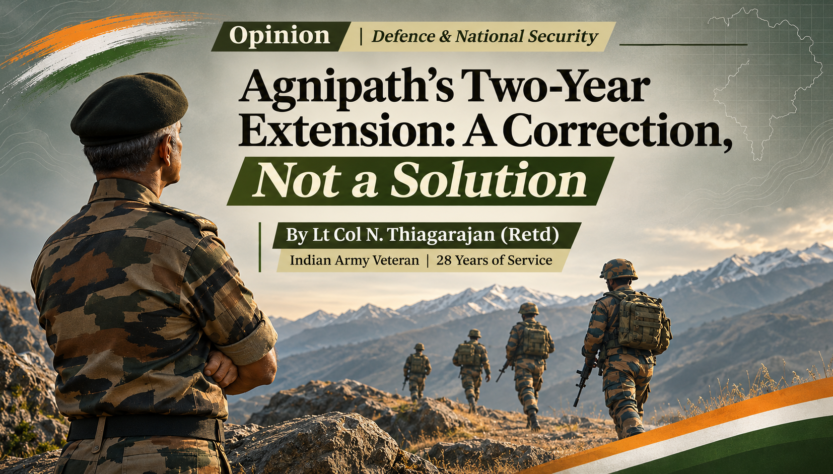
The Union Cabinet’s decision on 4 November 2026 to extend the service of Agniveers by two additional years is undoubtedly a welcome development. It acknowledges the value of retaining trained manpower and provides young soldiers with another opportunity to pursue a military career. However, the fundamental question remains unanswered: Can a six year engagement produce the experienced, battle ready and professionally mature soldiers that the Indian Armed Forces require?
Having served the nation for 28 years, rising through the ranks to the rank of Lieutenant Colonel, I view this development from the perspective of a soldier, a recruiting officer and a training officer. During my service, I was involved in recruiting thousands of young men into the Indian Army and had the privilege of serving in a training regiment, where raw recruits were transformed into disciplined soldiers.
These experiences taught me a fundamental military truth: Recruitment brings a young man into the Army. Training makes him a soldier. But years of operational exposure, responsibility and regimental life make him a dependable fighting professional.
That distinction must remain central to any discussion on military recruitment.
The Time Tested Recruitment System Was Designed for War, Not Merely Employment
Before the introduction of Agnipath in June 2022, the Indian Army followed a well established recruitment and career management system developed and refined over decades.
The recruitment process involved carefully structured assessments of physical fitness, medical standards, educational qualifications, aptitude and suitability for military service. Successful candidates entered regimental training establishments, where they underwent systematic military training before joining operational units.
The real education of a soldier, however, began after joining his battalion or regiment.
A young jawan learned from experienced soldiers, non commissioned officers, junior commissioned officers and officers. He absorbed the traditions of his regiment, developed confidence in handling weapons and equipment, and acquired the practical judgement essential for military operations.
The earlier system also provided a defined career structure. A soldier could progressively assume higher responsibilities as a Lance Naik, Naik, Havildar and, subject to selection and vacancies, advance into the Junior Commissioned Officer cadre. This progression was not merely a reward for years served. It was an essential mechanism for developing the Army’s junior leadership.
The system was not without shortcomings, and reform was certainly possible. Nevertheless, its greatest strength was continuity. It allowed soldiers to mature professionally while ensuring that younger recruits benefited from the knowledge and experience of their seniors.
Military effectiveness is built through generations of soldiers training, serving and learning together.
A Soldier Cannot Be Fully Developed in Four or Six Years
There is an important difference between a soldier who has completed basic training and one who has acquired operational maturity.
Modern warfare requires far more than physical fitness, rifle handling and elementary fieldcraft. Today’s soldier must understand sophisticated weapons, surveillance equipment, communication systems, tactical procedures, battlefield coordination and the increasingly complex technologies being introduced into the Armed Forces.
Consider the professional journey of an infantry soldier.
After initial training, he may serve in plains, deserts, mountains, high altitude areas, jungles or counter insurgency environments. Each operational setting presents different demands and requires specialised knowledge.
A soldier operating in the high altitude regions of Ladakh faces challenges entirely different from those encountered in the deserts of Rajasthan or the jungles of the Northeast. His proficiency develops through repeated field exercises, tactical employment, weapon training, operational deployments, specialist courses and exposure to the decisions taken by experienced commanders.
In my professional assessment, seven to eight years of progressively responsible service is often required to develop a well rounded, operationally experienced soldier, although the actual time varies considerably with the arm, trade and nature of employment.
At this stage, a soldier is no longer merely executing orders. He is increasingly capable of understanding battlefield situations, anticipating difficulties, guiding younger colleagues and exercising sound judgement under pressure.
To release such a soldier after six years, just as his experience is becoming particularly valuable, raises serious questions about the efficient utilisation of trained military manpower. The nation invests substantial resources in recruitment, training, equipment and operational development. That investment must be assessed not only in financial terms but also in the combat capability it produces over time.
Experience Is the Most Valuable Resource on the Battlefield
Military history repeatedly demonstrates that courage alone does not guarantee victory.
A successful fighting force requires a combination of youthful energy, disciplined leadership, technical proficiency, battlefield experience and mutual trust. An experienced soldier understands how to conserve ammunition, maintain equipment in difficult conditions, identify threats, respond to unexpected developments and support his comrades when operations do not unfold according to plan.
Many such skills cannot be adequately developed in classrooms or simulated exercises alone. They emerge from years of military service. The importance of experienced manpower becomes even greater in an Army operating advanced artillery systems, armoured platforms, drones, electronic warfare equipment, air-defence systems and modern battlefield communication networks.
Training a soldier to operate sophisticated equipment is only the first stage. Developing the ability to employ, maintain and troubleshoot that equipment under operational conditions requires sustained practical exposure. A recurring cycle of training young soldiers and releasing a substantial proportion of them after a short tenure risks weakening institutional expertise and increasing the burden on experienced personnel who must continuously train replacements.
Weapons can be manufactured, imported or modernised. Experienced soldiers cannot be produced overnight.
Regimental Spirit Cannot Be Measured in Contract Years
One of the greatest strengths of the Indian Army is its regimental system.
Regimental identity creates a sense of belonging, discipline, pride and responsibility that goes far beyond the terms of an employment contract. A soldier fights not only because he has received orders, but also because of his commitment to his comrades, his regiment and the nation.
This spirit develops through shared hardship, collective training, demanding deployments and the trust established between soldiers over time. A young recruit becomes part of a military family in which experienced soldiers guide him, correct his mistakes, strengthen his confidence and prepare him for greater responsibilities.
As a former training officer, I firmly believe that this process of transformation is among the most important responsibilities of the Army. A recruitment model dominated by short term service must therefore be assessed for its effect on regimental cohesion and leadership continuity.
There is also a concern about excessive competition for permanent absorption. While professional merit must always be rewarded, military institutions depend equally on teamwork, collective responsibility and the willingness to place the interests of the unit above individual advancement.
A section or platoon cannot function effectively if its members begin to view one another primarily as competitors for a limited number of permanent positions. The Army needs soldiers who succeed together, not individuals whose careers depend on outperforming their comrades at the expense of unit cohesion.
Senior Military Veterans Have Raised Similar Concerns
These concerns are not isolated observations.
Former Northern Army Commander Lt Gen D.S. Hooda, writing in The Indian Express in June 2022, urged that Agnipath should be subjected to a thorough assessment of its impact on operational capability before being treated as an unquestionable success.
Former Director General of Military Operations Lt Gen Vinod Bhatia, whose views were reported by India Today in July 2024, advocated extending the service period to at least seven or eight years, increasing retention to 50 per cent and providing longer service opportunities for technical personnel.
Maj Gen G.G. Dwivedi also emphasised the importance of regimental cohesion and the years required to transform a recruit into a dependable fighting soldier.
More recently, in August 2026, Lt Gen H.S. Panag argued for a comprehensively revised Agnipath framework that would better balance military effectiveness, career fairness, manpower requirements and financial sustainability.
These veterans do not necessarily advocate identical solutions. Their assessments nevertheless underline a common principle: Military manpower policy must be guided primarily by operational requirements, not by a uniform contractual tenure.
Two Additional Years Do Not Resolve the Career Progression Problem
The November 2026 revision retains the existing provision for 25 per cent of Agniveers to enter regular service after four years on merit. The remaining 75 per cent are being offered another two-year engagement, followed by an opportunity for regular enrolment subject to willingness and prescribed selection criteria.
The additional remuneration, enhanced Seva Nidhi and seniority benefits announced by the government are positive measures. However, several important questions deserve clear answers.
How many Agniveers will ultimately enter regular service after six years? How will their accumulated service count towards seniority, promotion and retirement benefits? Will their professional skills and operational experience receive appropriate recognition? What career security will exist for those who do not qualify for further enrolment?
Above all, how will the Armed Forces maintain an adequate pool of experienced soldiers and future junior leaders if short-term recruitment continues to form the principal route of entry?
These questions concern not only individual welfare but the long term structure and fighting effectiveness of the Armed Forces. A soldier who has served his nation in difficult and potentially dangerous conditions deserves clarity about his professional future.
The Way Forward: Restore the Strengths of the Earlier System
The government should treat the two year extension as an interim measure rather than the final answer to India’s military manpower requirements.
A comprehensive review of Agnipath should be undertaken, with particular attention to operational readiness, training effectiveness, career progression and the retention of experienced personnel. The time tested principles of long term regular recruitment should be restored as the foundation for core combat and specialist appointments, with adequate opportunities for soldiers to complete meaningful military careers.
The government should also establish an evidence based assessment system, drawing on feedback from field commanders, regimental centres, training establishments, operational formations and serving personnel. The views of veterans who have recruited, trained, commanded and served alongside soldiers should form a meaningful part of this exercise.
Such a review would be consistent with national interest and would demonstrate a willingness to refine defence policy in response to professional military experience.
National Security Must Remain the Final Test
After 28 years in uniform, including years spent recruiting and training young men for military service, I remain convinced that the Indian soldier is the foundation of our national security.
The finest equipment cannot compensate for inadequate training, insufficient operational experience or weakened junior leadership. The decision to extend Agniveer service from four to six years is an acknowledgement that trained soldiers are valuable and should not be released prematurely. But the same reasoning demands that we examine whether six years is itself adequate.
A nation’s military strength cannot be judged merely by how many young people it recruits or how much expenditure it saves. It must be judged by the quality of soldiers it develops, the experience it retains, the leadership it produces and its ability to prevail when confronted by war.
India does not merely need young soldiers. It needs young, experienced, technically competent and professionally motivated soldiers who can be relied upon in the most demanding circumstances.
A strong Army is built over decades, and a dependable soldier is developed over years.
Let us modernise our Armed Forces without weakening the time tested foundations of soldiering. Let us preserve youth and enthusiasm while retaining experience and professional maturity. Above all, let operational readiness not contractual convenience determine how long our soldiers serve.
For when the nation goes to war, it is not the terms of a recruitment scheme that defend our borders. It is the training, experience, courage and leadership of the soldier standing on the front line.

